ALTIVION × CANADIAN NUCLEAR LABORATORIES
Multi-Node Counter-UAS Detection
Designed for nuclear facility environments.
Prepared for the technical discussion with Stephen Cudmore and James Carr.
April 21, 2026 · 10:00 AM MT.
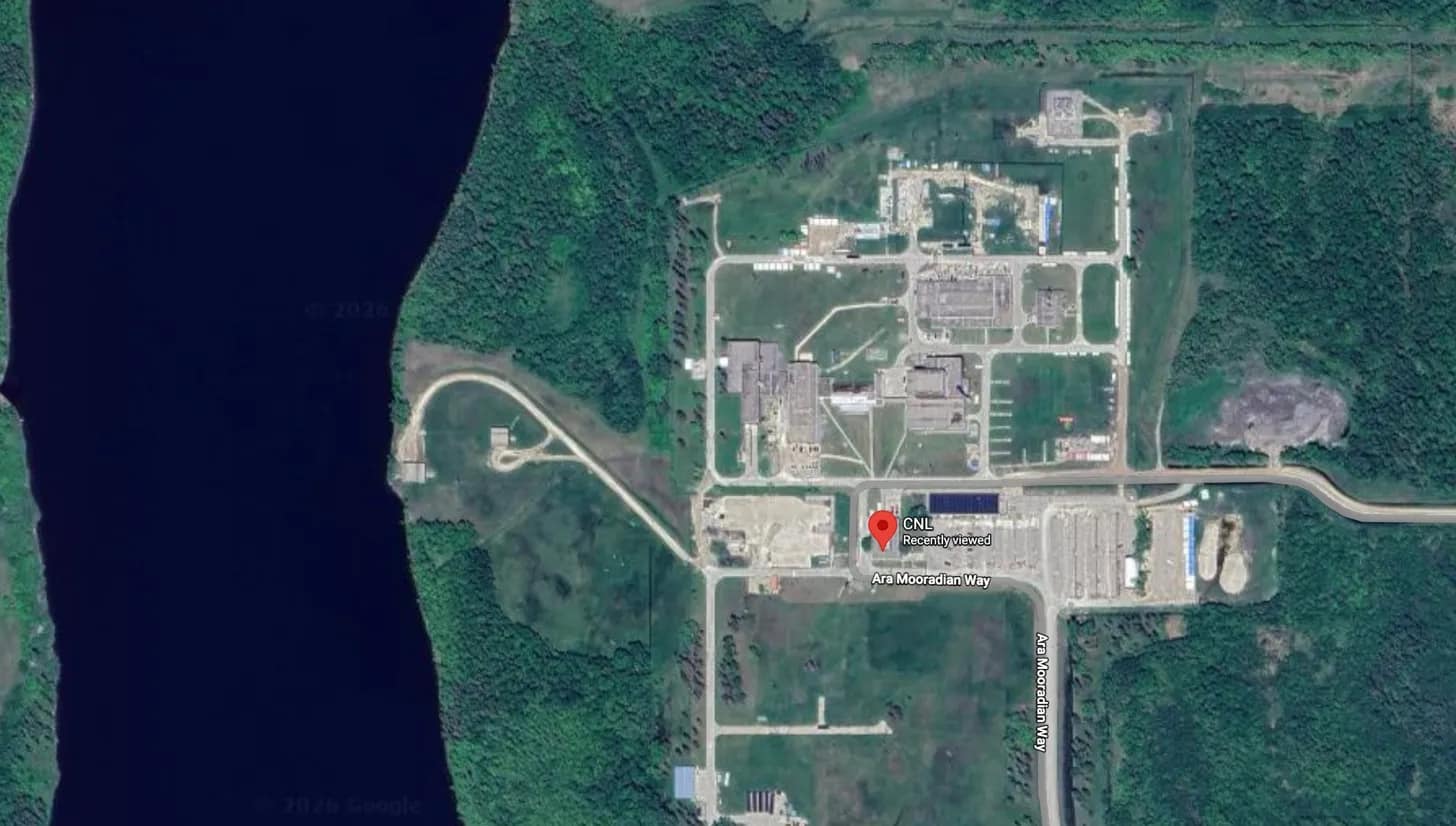
Node positions based on open-source satellite imagery — a working estimate for this discussion. Actual range, count, and placement will be scoped to your site.
02
From Handheld to Multi-Node
What we learned from the 2025 IDEaS CUAS Urban Sandbox, and why we evolved SilentRaven into a multi-node system.
Operators in high-security environments kept telling us the same thing. No cloud. No foreign supply chain in the detection path. Data must stay on-site, preferably air-gapped. Handheld units solve a different problem than perimeter protection.
A handheld device is limited by antenna size, shared processing, and battery draw. A fixed node can be larger, better-grounded, continuously powered, and elevated. In our field experience, raising a node — on a mast, a rooftop, or a tower — gives a material signal-to-noise advantage over ground-level handhelds. It hears more. It misses less.
Emergency response concepts of operations require continuous coverage. Handhelds need a human in the loop. Fixed multi-node networks do not sleep, do not get distracted, and do not need a trained operator on the perimeter at 03:00.
A single sensor is a point. A network is a fabric. Multi-node deployments cover larger areas, tolerate single-node failures, and enable cross-sensor verification to reduce false positives. Node data fuses at a local server, not in the cloud.
Feedback from DND and RCMP operators points in one direction: when coverage has to move, it has to move on a vehicle. Handheld units sound convenient on paper, but in sustained operations they get set down, forgotten, or run out of battery. Vehicle-mounted nodes are a distinct deployment mode we are designing for — not a handheld replacement.
This is why we evolved SilentRaven from handheld to a multi-node, passive, on-premise network. It reflects what sites like yours actually need, not what a handheld datasheet can deliver.
// Hear more. Miss less.
03
How SilentRaven Works
Passive RF detection, processed entirely on-site. No cloud dependency. Designed and built in Canada.
0
cloud calls
From detection to log storage
5KM
detection range
Validated detections only
0–6GHz
full-spectrum SDR
Covers all known drone frequencies
01 — Signal Capture
- SDR: Ettus USRP B210 (US)
- Broadband RF intake
- GPS time sync
02 — Local Processing
- Raspberry Pi 5
- Altivion carrier PCB
- RID: ASTM F3411 / MIIT
- DJI model classifier
03 — Multi-Node Fusion
- Cross-node de-duplication
- TDOA localization
04 — On-Premise Server
- Air-gap capable
- Hash-signed flight logs
- No cloud dependency
05 — Operator Output
- Web dashboard (Leaflet)
- iOS reference client
- REST / MQTT API
Every stage runs on-site. No signal, no metadata, no log leaves the facility unless you export it.
SUPPLY CHAIN PROVENANCE
System architecture · carrier PCB · software stack · RID database
Ettus Research USRP B210 SDR front-end (Analog Devices / NI)
Detection, compute, and communications components sourced exclusively from Canada, US, and allied nations
Passive acoustic and TDOA detection for non-cooperative drones (RID-off, hobbyist-modified, or dark-signature platforms) is under active research collaboration with Dr. Abraham Fapojuwo and his team at the University of Calgary, under the Department of National Defence's Defence Innovation Secure Hubs (DISH) program. This capability is not in the current SilentRaven production baseline. It is in our 12-month roadmap.
FIELD CONFIGURATION OPTIONS
Enclosure IP rating
Industrial-grade per site requirements
Operating temperature
–40°C to +40°C via selected compute and heating modules
Communications
Ethernet, 4G/LTE, or fiber per site infrastructure
Power
PoE, solar-battery hybrid, or site mains per deployment geometry
Detailed architecture, PCB design, software stack documentation, and algorithm descriptions are available under NDA.
// Local processing. No exceptions.
04
What We Need to Understand From You
To scope a real deployment, we need to understand these. We don't expect answers to all of them today.
Operational Requirements
- ·Coverage area and specific zones to protect (perimeter, airspace layers, standoff distance)
- ·Target threat classes (small quadrotor, fixed-wing, swarm scenarios)
- ·Operational environment (all-weather profile, seasonal range, RF ambient noise)
- ·Integration with existing Emergency Operations Centre and response protocols
IT & Security Constraints
- ·On-premise data retention policies (duration, storage location, access controls)
- ·Network architecture (air-gapped, segmented, permitted VLANs)
- ·Supply chain audit requirements (BOM disclosure, country-of-origin restrictions)
- ·Cybersecurity certification expectations (ITSG-33, NIST SP 800-53, CSE guidance)
Regulatory & Process
- ·CNSC physical security framework touchpoints
- ·Transport Canada airspace coordination (existing CYR, TFR, or NOTAM arrangements)
- ·Site access and security clearance requirements for our team
- ·Internal decision process for pilot engagement
Some of these you'll answer today. Some will need colleagues who aren't in the room. That's expected.
// Scoping is work. Scoping is not a commitment.
05
Proposed Engagement Path
Built around your internal gates, not ours.
STEP 01
TODAY
Technical Discussion
Walk through this briefing together. Mutual scoping. Identify internal stakeholders on both sides.
STEP 02
WEEK 1–2
NDA and Requirements Exchange
Mutual NDA execution. Virtual technical deep-dive with your SMEs. Requirements document exchanged under NDA.
STEP 03
WEEK 3–6
Joint Scoping Document
Site geometry review. Threat scenario definition. Integration and IT constraints mapped. Output: a Phase 1 proposal with a defensible cost envelope.
STEP 04
MONTH 2+
Phase 1 Engagement
Scoping and design contract. Leads to pilot decision at your internal gate.
STEP 01
TODAY
Technical Discussion
Walk through this briefing together. Mutual scoping. Identify internal stakeholders on both sides.
STEP 02
WEEK 1–2
NDA and Requirements Exchange
Mutual NDA execution. Virtual technical deep-dive with your SMEs. Requirements document exchanged under NDA.
STEP 03
WEEK 3–6
Joint Scoping Document
Site geometry review. Threat scenario definition. Integration and IT constraints mapped. Output: a Phase 1 proposal with a defensible cost envelope.
STEP 04
MONTH 2+
Phase 1 Engagement
Scoping and design contract. Leads to pilot decision at your internal gate.
No procurement commitment is required until Phase 1. The first three steps are scoping work. Each produces a document you can share internally.
// Standard phasing. No surprises.
06
Commercial Model
Standard phased structure — you only commit to the next step.
// STANDARD DEFENSE AND NUCLEAR INDUSTRY PHASING
Phase 1 Scoping & Design
DELIVERABLE
Site design, node placement plan, integration specification, IT security documentation package, FAT plan
PRICING BASIS
Fixed-price engagement
ACCEPTANCE GATE
CNL sign-off on design package
Phase 2 Build & Deployment
DELIVERABLE
Manufactured nodes, integrated edge appliance, Factory Acceptance Test at Altivion facility, Site Acceptance Test at CNL, initial operator training
PRICING BASIS
Fixed-price per deployment scope
ACCEPTANCE GATE
Successful SAT sign-off
Phase 3 Operational Acceptance
DELIVERABLE
30-day operational reliability demonstration, full documentation handover, transition to sustainment
PRICING BASIS
Final milestone payment
ACCEPTANCE GATE
Operational acceptance certificate
Annual O&S
DELIVERABLE
Preventive maintenance, firmware and RID database updates, calibration, incident response support
PRICING BASIS
Annual fee as % of Phase 2 system value. Tiers: business hours / extended hours / 24/7 on-call
ACCEPTANCE GATE
Defined at Phase 1
IP OWNERSHIP
Altivion retains all background IP including the RID parsing engine, DJI model classifier, multi-node de-duplication algorithm, and the integration software stack. CNL-funded customization results in joint foreground IP per the Phase 1 agreement. All source code and design documentation are escrowed at a mutually agreed Canadian escrow agent as a standard condition of Phase 1.
Indicative cost envelope will be provided after the April 21 discussion, once operational scope is clarified. We do not quote without understanding the site.